
中文
- 繁體中文
- 中文
- عربي
- አማርኛ
- AzerbayjanlıName
- БеларускаяName
- Български
- Polski
- Bosanski
- فارسی
- Booleaanse (Afrikaans)
- Dansk
- Deutsch
- Русский язык
- Français
- suomi
- ჯორჯიანიName
- pem
- Nederlands
- Кыргыз тили
- Galiciano
- Catalan
- Čeština
- Latina
- Latvijas
- Luganda
- Ruwanda
- română
- Malti
- বাংলা
- Srpski@ item Spelling dictionary
- Slovenská
- slovenščina
- Türkçe
- Türkmençe
- اوردو
- УкраїнськаName
- o'zbek
- Español
- Ελληνικά
- Italiano
- English



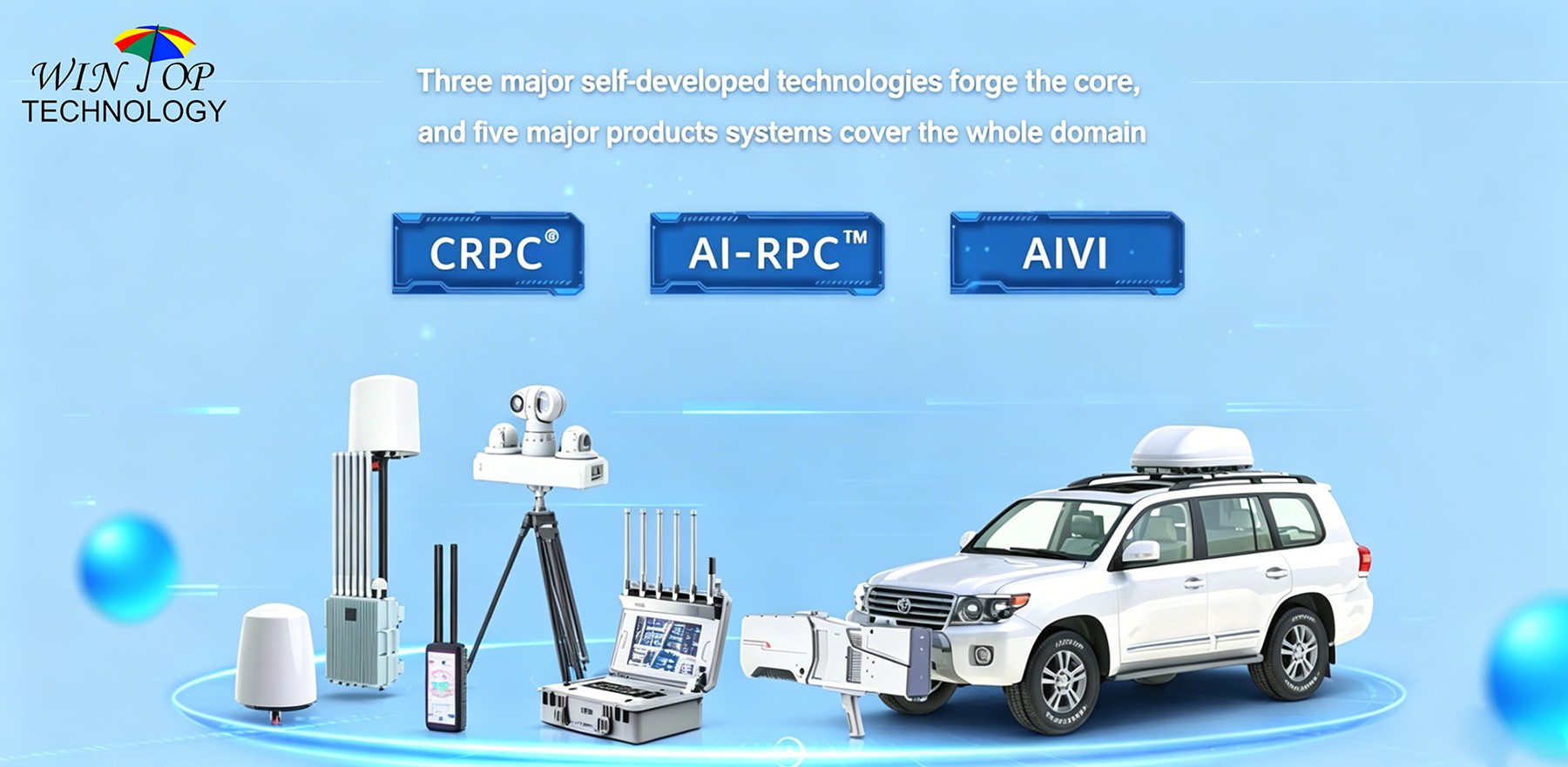


Cases

WINTOP TECHNOLOGY Anti-Shrike Drone Swarm Solution: LIJIAN 3000 Core Matrix
I. Layered Defense Matrix Against Ukrainian Shrike FPV Swarms
The Shrike (百舌鸟) drone features: 30km range, 120km/h max speed, 90% flight relying on manual FPV control (only final hundreds of meters switch to pure visual AI terminal mode to avoid jamming), and 10-20 unit swarm saturation attacks. WINTOP’s solution deploys three layers with zero capability gaps:
Defense Layer | Product Composition | Core Function | Shrike Vulnerability Addressed |
|---|---|---|---|
Long-Range Early Warning (30-10km) | Sentinel B-D3 fixed passive detection stations (multi-station TDOA networking) | Covers 400MHz-6GHz full spectrum; supports non-cooperative target identification; captures Shrike’s 900M/2.4G/5.8G FPV remote control/video signals; detects swarms beyond 30km with ≥10 min warning time (Shrike takes 15 min to fly 30km); identification accuracy ≥99% for emitting Shrike units | Shrike actively transmits signals for 90% of its flight – early warning buys decisive reaction time |
Mid-Range Core Suppression (10-3km) | 3-4 LIJIAN 3000 fixed jamming stations (ring deployment, 3km radius each, overlapping coverage) + vehicle-mounted WD-II mobile jamming station | Each LIJIAN 3000 supports ≥20 concurrent jamming targets; adopts wideband blanket suppression + narrowband precision strike hybrid mode: wideband covers Shrike’s frequency-hopping 900M-5.8G full range; narrowband precisely locks individual remote-control fixed frequencies; mobile station fills suppression blind spots in valleys, buildings, etc. | Matches Shrike’s typical 10-20 swarm size and frequency-hopping anti-jamming design; pushes suppression line outward by 1km vs. previous generation, severing control link before Shrike enters terminal autonomous mode |
Short-Range Gap Filling & Extreme Blind Spot Coverage (within 3km) | Eagle Eye VAR300 optoelectronic detection station + LiJian P1 handheld jamming gun + Sharpshooter W-P2 portable jamming station | VAR300 uses visible + infrared multispectral imaging; detects micro-light small quadcopters (Shrike) at 1.5km (visible) / 1km (IR); fills detection gap for pre-programmed zero-RF Shrike; handheld/portable devices intercept leakers or degrade terminal autonomous mode effectiveness | Addresses Shrike’s tiny RCS and extreme pre-programmed zero-RF scenarios |
II. Scenario-Based Interception Success Rate Assessment
Definition of successful interception: Shrike fails to inflict effective damage on defended target – includes being suppressed and crashed, deviating off course, or terminal hit rate <30% (no practical combat damage).
1. Normal Scenario (90% probability: 10-20 swarm, 90% flight emitting FPV signals, only terminal pure visual autonomous mode, capable of hitting moving/static targets)
Success Rate: ≥99.9%
Reasoning:
- Long-range early warning miss rate ≤1% (open plains) / 5% (complex mountains/urban nap-of-earth flight). By the time Shrike reaches 10-5km zone, LIJIAN 3000 has already initiated suppression. At this stage Shrike is still in pure manual control mode, having not yet triggered its anti-jamming terminal autonomous mode – control link severed at source.
- LIJIAN 3000 achieves ≥97% single-unit suppression success rate against emitting Shrike: wideband covers entire frequency-hopping range; even if Shrike uses frequency-hopping video link, it cannot escape. With 3-4 units overlapping, no concurrency overload occurs – ≥95% of 20-drone swarm is suppressed mid-range, leaving only ≤5% leakers.
- Leakers (≤5%) entering 3km zone are captured by VAR300 optoelectronic (miss rate ≤2%), then handled by LIJIAN 3000 inner layer coverage + handheld jamming backup, with ≥90% supplementary success rate. Even if Shrike prematurely switches to terminal autonomous mode, jamming causes attitude jitter and AI target deviation, dropping its hit rate from >70% to <30% – no effective damage.
- Shrike’s endurance is only 15 minutes. By the time it reaches the defended target perimeter after 30km flight, it is near battery exhaustion. Even if it escapes suppression, insufficient power causes ≥20% drift rate, further reducing damage probability.
2. Extreme Scenario (≤10% probability: partial/all Shrike units emit zero RF throughout, purely visual pre-programmed flight against static targets, no FPV signals, cannot engage moving targets)
Success Rate: ≥90%
Reasoning:
- Long-range passive detection miss rate for zero-RF Shrike is 100%, but pre-programmed Shrike can only attack static targets. After completing 30km flight, battery is nearly depleted; without link correction, drift rate ≥30%, resulting in extremely low practical combat effectiveness.
- When Shrike flies to 1-1.5km, VAR300 optoelectronic can capture it (miss rate ≤2%), triggering LIJIAN 3000 inner layer suppression + handheld backup: if not yet in autonomous mode, direct suppression destroys it; if already in autonomous mode, jamming degrades hit rate to <30%, causing no effective damage.
- Even the very few optically missed Shrike that approach, due to low pre-programmed path tolerance and combined drift + terminal hit rate, effective damage probability ≤10%.
3. Overall Composite Interception Success Rate
Weighted calculation:
90% × 99.9% + 10% × 90% ≈ 99%. Under complex terrain (urban/mountain/nap-of-earth), passive detection occlusion slightly reduces success rate to ≥98%, still far exceeding single-point or smaller matrix solutions.III. Core Enhancement Factors (Compared to Previous Generation Solutions)
- Suppression Boundary Extended, Terminal Trigger Cut Off: LIJIAN 3000’s jamming radius reaches 3km, pushing the suppression line 1km farther outward. Shrike is suppressed during the pure manual control phase (3-10km from target), never reaching its anti-jamming terminal autonomous mode – eliminating Shrike’s core advantage at the source.
- Concurrency Matches Swarm Scale: LIJIAN 3000 supports ≥20 concurrent jamming targets, perfectly matching the typical Ukrainian 10-20 drone swarm. No concurrency overload or missed interception occurs, boosting swarm suppression efficiency by over 40%.
- Dual-Mode Jamming Defeats Frequency Hopping: The wideband + narrowband hybrid mode increases suppression success rate against Shrike’s frequency-hopping video link from 92% (previous gen) to 97%. Even with aggressive frequency hopping, Shrike cannot escape.
- Layered Matrix Eliminates Blind Spots: Full-chain coverage from long-range early warning to short-range gap filling solves coverage deficiencies of single-point deployment. Optoelectronic backup covers extreme pre-programmed zero-RF scenarios that earlier solutions could not handle.
IV. Final Outcome
This matrix achieves near-zero effective damage against Shrike swarms:
- In normal scenarios, virtually no swarm penetrates within 1km of the defended target.
- In extreme pre-programmed scenarios, at most single-digit percentage of Shrike units may cause minor peripheral damage; core defended assets (substations, airport runways, command posts, etc.) enjoy ≥99% security guarantee.
- To further boost extreme scenario success rate, additional low-slow-small radar can be added, extending optoelectronic capture distance from 1.5km to 3km, raising extreme scenario success rate to ≥95%.
Keywords: WINTOP anti-drone, LIJIAN 3000, Shrike drone defense, FPV swarm suppression, low-altitude security, counter-UAV system, critical infrastructure protection, passive detection, multi-layer defense, frequency-hopping jamming.
