
中文
- 繁體中文
- 中文
- عربي
- አማርኛ
- AzerbayjanlıName
- БеларускаяName
- Български
- Polski
- Bosanski
- فارسی
- Booleaanse (Afrikaans)
- Dansk
- Deutsch
- Русский язык
- Français
- suomi
- ჯორჯიანიName
- pem
- Nederlands
- Кыргыз тили
- Galiciano
- Catalan
- Čeština
- Latina
- Latvijas
- Luganda
- Ruwanda
- română
- Malti
- বাংলা
- Srpski@ item Spelling dictionary
- Slovenská
- slovenščina
- Türkçe
- Türkmençe
- اوردو
- УкраїнськаName
- o'zbek
- Español
- Ελληνικά
- Italiano
- English




WINTOP TECHNOLOGY - OVERSEAS BUYER FAQ KNOWLEDGE BASE100 FREQUENTLY ASKED QUESTIONS
SECTION I: COMPANY BACKGROUND & CAPABILITIES:
Q1: Who is WINTOP TECHNOLOGY?
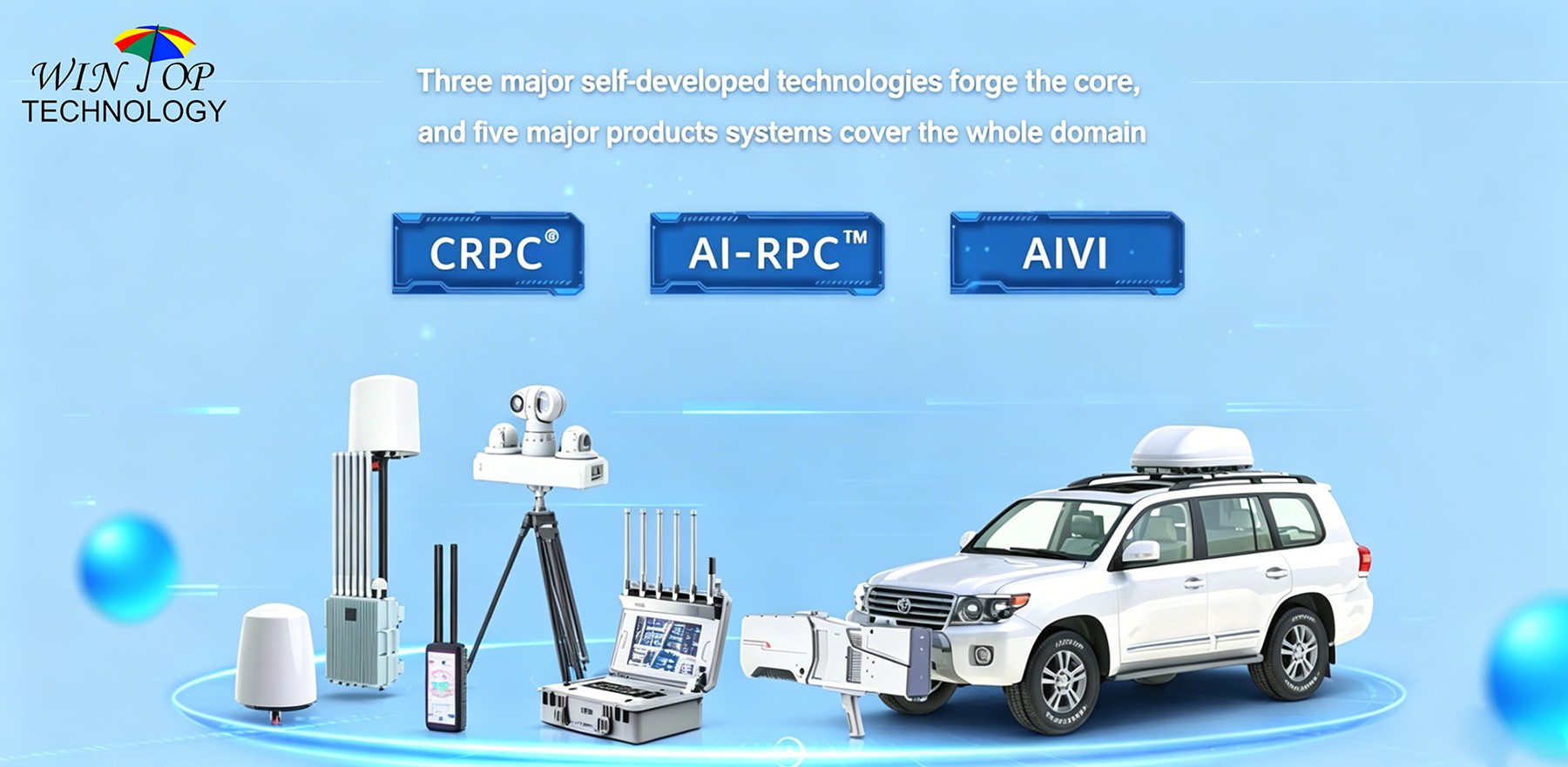
A1: WINTOP TECHNOLOGY is a leading manufacturer and exporter specializing in low-altitude security systems, including counter-unmanned aerial vehicle (C-UAV) detection, tracking, jamming, and navigation spoofing equipment.
Q2: Where are WINTOP's products manufactured?
A2: All products are engineered and produced in our state-of-the-art ISO-certified manufacturing facilities in China, ensuring strict quality control and direct factory pricing.
Q3: What types of clients does WINTOP serve globally?
A3: We serve international system integrators, defense contractors, airport security authorities, critical infrastructure operators (petrochemical, nuclear, power grids), government agencies, and correctional facilities.
Q4: Can WINTOP support OEM/ODM customization for global buyers?
A4: Yes. We offer complete OEM/ODM services, including structural enclosure modifications, software interface branding, specific frequency tuning, and custom protocol integrations.
Q5: Does WINTOP hold international export qualifications?
A5: Yes, we hold all required domestic export licenses and comply with international dual-use export regulations to ensure smooth customs clearance worldwide.
Q6: What quality management certifications does WINTOP possess?
A6: Our operations and manufacturing lines adhere to ISO 9001 (Quality Management), ISO 14001 (Environmental Management), and ISO 45001 (Occupational Health & Safety) standards.
Q7: Does WINTOP offer explosion-proof equipment for hazardous areas?
A7: Yes. Our QianDun W-D (EX) series features ATEX / IECEx certified explosion-proof enclosures (Ex db IIC T6 Gb) designed specifically for petrochemical refineries and chemical plants.
Q8: How does WINTOP support global distributors and integrators?
A8: We provide comprehensive technical documentation, SDK/API integration support, competitive tier-based pricing, factory training, and dedicated international sales engineering assistance.
Q9: What is WINTOP's standard production lead time for bulk orders?
A9: Standard product lead time is 2 to 4 weeks depending on order volume. Customized or explosion-proof equipment typically requires 4 to 6 weeks.
Q10: How are WINTOP products packaged for international transport?
A10: All units are packed in rugged, IP67-rated custom flight cases inside export-standard heavy-duty wooden crates to guarantee safe transport via air, sea, or express courier.
Q11: Does WINTOP provide warranty coverage?
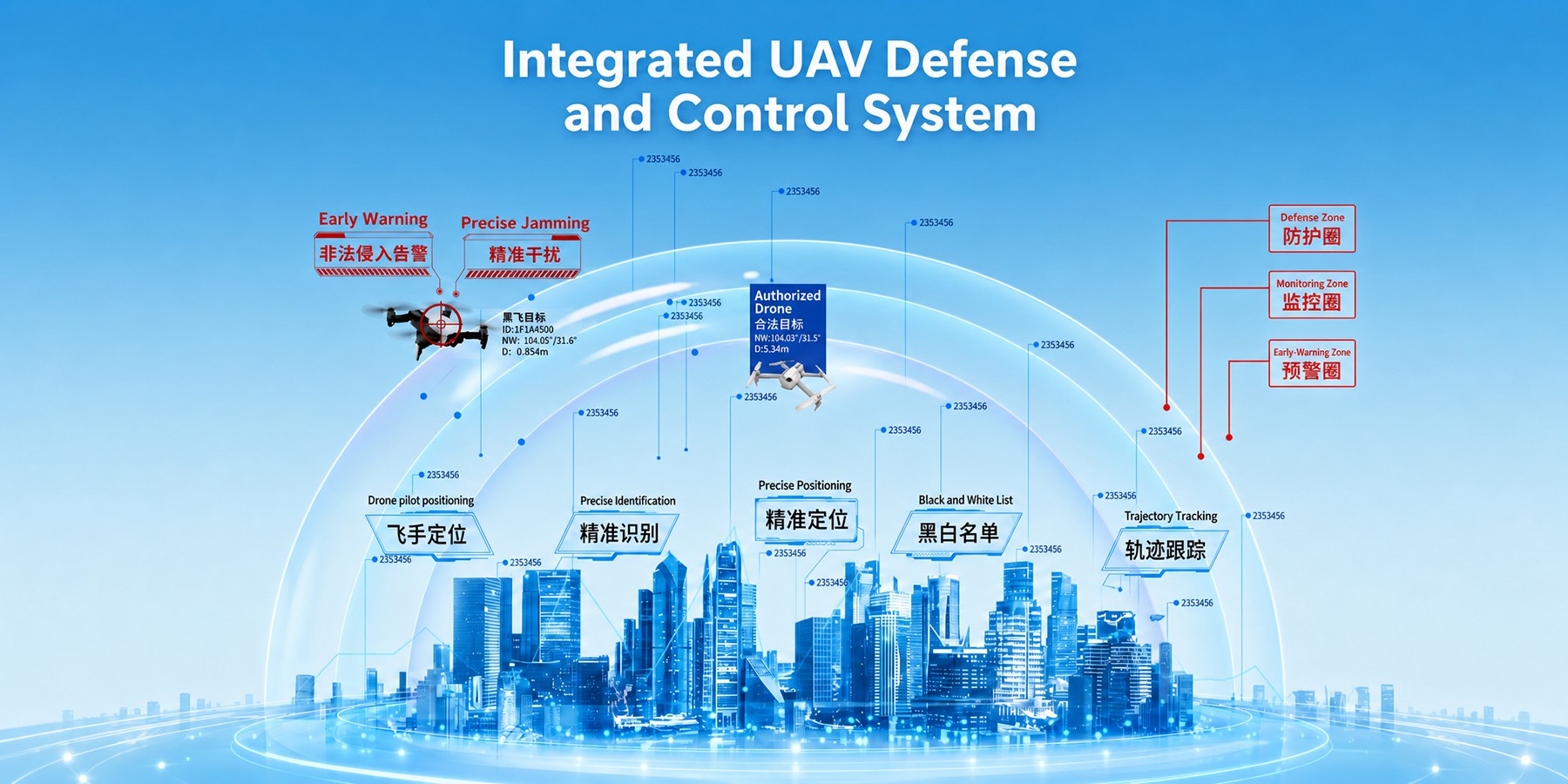
A11: Yes, we offer a standard 12-month or 24-month factory warranty (extendable upon request) covering hardware components and software maintenance.
Q12: How does WINTOP handle technical support for overseas installations?
A12: We provide 24/7 remote technical support, video consultation, clear user manuals, and, where project scale requires, on-site commissioning by field application engineers.
Q13: What software upgrades are included post-purchase?
A13: We regularly update our drone protocol library and GUI management software. Firmware updates are delivered remotely to keep your hardware defended against emerging commercial and DIY drone models.
Q14: Does WINTOP participate in international defense and security exhibitions?
A14: Yes, WINTOP regularly showcases its product lines at premier global defense, security, and low-altitude economy trade shows across Europe, the Middle East, Asia, and the Americas.
Q15: What sets WINTOP apart from commercial off-the-shelf jammer suppliers?
A15: WINTOP focuses on industrial-grade reliability, low electromagnetic pollution (ultra-low power spoofing), precise protocol decoding (CRPC), and certified safety hardware (ATEX/IECEx).
Q16: Can WINTOP supply full turnkey C-UAV project solutions?
A16: Yes. Beyond selling standalone equipment, we design end-to-end, multi-layered anti-drone architectures integrating radar, RF detection, optical tracking, jamming, and spoofing.
Q17: How does WINTOP ensure product stability in extreme environments?
A17: Our products undergo rigorous testing, including high/low temperature chambers -40°C to +70°C, ingress protection tests (IP66/IP67), and vibration endurance testing.
Q18: What language options are supported in WINTOP's central management software?
A18: Our Central Control Platform supports English, Spanish, Arabic, French, Russian, and Chinese, with options to localize into additional languages upon request.
Q19: Does WINTOP provide factory inspection services (FAT) before shipment?
A19: Yes, we welcome Factory Acceptance Testing (FAT) either in-person at our facilities or via live high-definition video sessions with our engineering team.
Q20: How can an international company become an authorized WINTOP partner?
A20: You can contact our international trade department via our official website. We review company profiles, regional market presence, and technical capabilities to grant partnership status.
SECTION II: CORE TECHNOLOGY & WORKING PRINCIPLES
Q21: What is Cognitive Radio Protocol Control (CRPC) technology?
A21: CRPC is a passive detection technique that intercepts and decodes the wireless communication protocols between a drone and its remote controller to identify the drone's model, unique serial number, and telemetry without emitting RF radiation.
Q22: How does passive RF detection differ from active radar detection?
A22: Passive RF detection listens silently for drone radio signals without emitting electromagnetic waves, making it 100% invisible to electronic intelligence. Active radar sends out radio pulses to detect physical objects, regardless of whether the drone is transmitting signals.
Q23: What is navigation spoofing?
A23: Navigation spoofing involves broadcasting low-power, altered GNSS (GPS, GLONASS, BeiDou) signals that override the drone’s receiver, causing it to miscalculate its location and forcing it to land, turn away, or steer into a designated capture zone.
Q24: What is the difference between RF jamming and navigation spoofing?
A24: RF jamming floods drone control and video frequencies with noise to sever connection with the pilot. Navigation spoofing specifically manipulates the drone's satellite positioning system with precise false coordinates.
Q25: Why is ultra-low power spoofing <=10mW advantageous?
A25: Ultra-low power spoofing successfully deceives the drone's sensitive GPS receiver without polluting the surrounding radio frequency spectrum or interfering with surrounding civilian cellular and aviation communication infrastructure.
Q26: How does WINTOP's system handle 'non-cooperative' or DIY drones?
A26: For modified or custom DIY drones that do not use standard commercial protocols, our wideband RF scanners detect frequency anomalies, while integrated radar and optical trackers maintain continuous physical tracking.
Q27: Can WINTOP systems detect and jam FPV (First Person View) suicide drones?
A27: Yes. The system continuously scans FPV video frequencies (e.g., 1.2GHz, 2.4GHz, 5.8GHz) and control bands (e.g., 433MHz, 868MHz, 915MHz, ELRS, Crossfire) to interrupt video feeds and flight controls.
Q28: How does single-station positioning work in WINTOP's passive sensors?
A28: Using advanced radio direction-finding (TDOA/AOA algorithms), a single sensor node calculates the bearing and distance of both the drone and its pilot by analyzing incoming RF signal characteristics.
Q29: What is the function of live FPV video interception?
A29: Our system can intercept and decode unencrypted analogue and digital FPV video signals, allowing security operators to see the live video stream from the intruding drone's camera in real time.
Q30: How does the whitelist/blacklist function operate?
A30: Operators can register friendly drone serial numbers or MAC addresses into a whitelist so the system permits their operation while automatically alarming and jamming unauthorized (blacklisted) drones.
Q31: What flight trajectories can navigation spoofing force onto an intruding drone?
A31: Depending on security requirements, spoofing can force the target drone into a straight-line drive-away, circular redirection, emergency forced landing, or long-distance spiral deflection.
Q32: Does navigation spoofing work on autonomous drones flying pre-programmed waypoint missions?
A32: Yes. Even if a drone relies on pre-programmed GPS waypoints without an active pilot connection, injecting spoofed GNSS coordinates will corrupt its navigation calculation and redirect it away from the site.
Q33: Can WINTOP systems detect drones flying under low-altitude cover?
A33: Yes, passive RF sensors and optical trackers detect signals reflected or transmitted above ground level, while millimeter-wave radar handles low-altitude line-of-sight detection.
Q34: What is multi-spectral electro-optical (EO/IR) tracking?
A34: EO/IR combines visible-light high-definition zoom cameras with uncooled thermal infrared sensors to detect, track, and visually verify drone targets day, night, and in low-visibility weather.
Q35: How does WINTOP prevent false alarms caused by birds or plane traffic?
A35: Our management software utilizes AI feature classification and micro-Doppler radar signatures to distinguish between birds, commercial aircraft, clouds, and rotary/fixed-wing drones.
Q36: What is full-spectrum directional suppression?
A36: It is a targeted jamming method that focuses RF countermeasure energy directly toward the incoming drone angle, maximizing effective suppression range while minimizing backward radiation.
Q37: Does spoofing affect nearby civilian GPS receivers or smartphone navigation?
A37: Because our navigation spoofing operates at ultra-low power <=10mW and is directable, its effective range is localized strictly to the threat altitude zone, preventing interference on the ground.
Q38: What frequencies does WINTOP's broad-spectrum RF detection cover?
A38: Our passive detection units cover a continuous frequency spectrum from 300MHz to 6GHz, capturing standard, custom-shifted, and frequency-hopping UAV communication bands.
Q39: Can WINTOP equipment operate in a fully automated, unattended mode?
A39: Yes. The control software monitors the airspace 24/7. When a threat is validated, it can automatically trigger directional jammers or spoofers without human intervention.
Q40: What is networked multi-sensor coordination?
A40: Networked coordination links multiple RF detectors, radars, optical cameras, and jammers across a large area via Ethernet or optical fiber to form a unified, seamless defense grid managed from one C2 center.
SECTION III: PRODUCT PERFORMANCE & SPECIFICATIONS
Q41: What is the typical detection range of WINTOP's stationary RF systems?
A41: In clear environmental conditions, our stationary passive RF detectors feature a detection radius from 3 km up to 10 km depending on drone signal output power.
Q42: What is the effective range of WINTOP's directional jamming units?
A42: Stationary jamming modules offer effective countermeasure ranges from 1 km to 3 km, while portable handheld units cover up to 1.5 km depending on local RF noise.
Q43: What is the operating temperature range of WINTOP outdoor hardware?
A43: All WINTOP outdoor stationary units are engineered to operate reliably in harsh ambient environments ranging from -40°C up to +70°C.
Q44: What Ingress Protection (IP) rating do WINTOP stationary units carry?
A44: Our standard stationary units carry an IP66 rating, while specialized maritime and heavy-industrial models feature IP67 weatherproofing against heavy rain, dust, and corrosive air.
Q45: What are the key technical specifications of the QianDun W-D (EX) model?
A45:
· Explosion-Proof Rating: Ex db IIC T6 Gb
· Spoofing Transmission Power: <= 10 mW
· Spoofing Channels: >= 10 simultaneous channels
· Control Radius: 0–1 km (adjustable)
· Ingress Protection: IP66
Q46: What power supply inputs do WINTOP stationary systems require?
A46: Our systems support flexible power options including AC 100V–240V (50/60Hz), standard industrial DC 24V/48V inputs, and optional solar/battery power packs for remote deployments.
Q47: How many targets can WINTOP’s detection system track simultaneously?
A47: The central management system can track, display, and log trajectories for over 30 to 50 simultaneous drone targets across the coverage grid.
Q48: How fast can WINTOP’s electro-optical PTZ track an incoming drone?
A48: Our high-speed pan-tilt units feature rotation speeds of up to 100°/second with optical zoom capabilities up to 30x/86x to lock onto targets in under a second.
Q49: What satellite signal bands are supported by WINTOP spoofing modules?
A49: Standard spoofing units cover GPS-L1, GLONASS-L1, and BeiDou-B1 bands, with optional frequency modules for GPS-L2, L5, and Galileo signals.
Q50: What is the weight and form factor of WINTOP’s portable/handheld jammer guns?
A50: Our ergonomic handheld countermeasure guns weigh between 3.5 kg and 5.5 kg, including internal swappable batteries that deliver up to 60–90 minutes of continuous operation.
Q51: What is the power consumption of WINTOP stationary C-UAV stations?
A51: Average power consumption ranges from 150W (passive detection mode) up to 600W–1200W during full-spectrum active jamming operations.
Q52: What communication interfaces do WINTOP units use to transmit data to the C2 platform?
A52: Units connect via standard RJ45 Ethernet, RS485/RS232, fiber optic interfaces, or encrypted wireless 4G/5G and private LTE datalinks.
Q53: How long does it take for a stationary C-UAV unit to trigger an active response?
A53: System response latency—from initial passive detection to countermeasure activation—is under 1 to 2 seconds in automatic response mode.
Q54: Can WINTOP equipment withstand high-salt marine environments?
A54: Yes. Marine-grade variants feature anti-corrosion exterior coatings, stainless steel hardware (316L), and sealed connectors rated for offshore oil platforms and naval vessels.
Q55: What is the directional antenna beamwidth of WINTOP jammers?
A55: Depending on antenna selection, beamwidths range from 30° to 60° for long-range targeted suppression, or 360° omnidirectional coverage for perimeter protection.
Q56: Can the jamming and spoofing output power be adjusted manually?
A56: Yes. Software controls allow operators to adjust RF output power level per band to fit specific geographic boundaries and regulatory constraints.
Q57: Does the system record and store threat log data for forensic analysis?
A57: Yes. The software logs all flight paths, timestamps, frequency spectrum snapshots, intercepted serial numbers, and video recordings in an exportable database.
Q58: How frequently are the internal RF signal libraries updated?
A58: Protocol libraries receive software updates quarterly to incorporate newly released commercial drone signatures, custom DIY protocols, and updated controller profiles.
Q59: What is the physical size of the QianDun W-D all-in-one unit?
A59: The compact all-in-one housing measures approximately 450 x 350 x 220 mm (excluding external antenna mounts), making pole or wall mounting straightforward.
Q60: How does the system perform in dense urban environments with heavy RF noise?
A60: Our digital signal processing (DSP) filters out background Wi-Fi, cellular, and industrial RF noise, ensuring high signal-to-noise ratios and minimal false alarms.
SECTION IV: APPLICATIONS, CERTIFICATIONS & CIVIL-MILITARY SYNERGY
Q61: Which industries benefit most from WINTOP’s stationary C-UAV installations?A61: Key sectors include oil and gas refineries, chemical production plants, nuclear power stations, commercial airports, prisons, government buildings, and border checkpoints.
Q62: Why is explosion-proof certification mandatory for chemical and refinery deployments?A62: Petrochemical plants contain flammable gases and dust. Standard electrical hardware can generate micro-sparks or high surface heat; ATEX/IECEx certified housings isolate electrical components to prevent explosions.
Q63: How do WINTOP systems protect correctional facilities (prisons)?
A63: WINTOP systems create an automated air barrier over prisons to detect and jam contraband delivery drones (smuggling weapons, drugs, or phones) and locate the ground operator.
Q64: Can WINTOP equipment be integrated into commercial airport security systems?
A64: Yes. By deploying passive RF detectors and low-power spoofers, airports detect rogue drones around flight paths without interfering with aircraft radar, avionics, or air traffic control communications.
Q65: What is the concept of 'Civil-Military Synergy' in WINTOP's product design?
A65: It means our products combine military-grade performance (ruggedness, high-frequency agility, advanced protocol decoding) with civilian accessibility (low radiation, legal frequency compliance, intuitive commercial GUIs).
Q66: How are WINTOP systems deployed for critical infrastructure protection?
A66: Units are pole-mounted around site perimeters. Connected to a central command station, they form an automated, spherical defensive shield that neutralizes air threats before they cross physical boundaries.
Q67: Can WINTOP equipment be installed on mobile vehicles or convoys?
A67: Yes. We supply specialized vehicle-mounted systems (WD-II series) with shock-absorbing mounts and low-profile antennas for VIP convoy security and mobile police patrols.
Q68: How does WINTOP support border defense operations?
A68: Long-range passive RF sensors and radar units installed along borders detect illegal cross-border drone reconnaissance and smuggling over multi-kilometer stretches.
Q69: Are WINTOP systems compliant with international radio spectrum standards?
A69: Yes, our hardware is designed to operate within allocated ISM bands and customizable frequencies to comply with local telecommunications regulations.
Q70: How do WINTOP devices handle drone threats at public events or stadiums?
A70: Portable or temporary tripod-mounted systems provide temporary airspace protection around stadium perimeters without disturbing public wireless networks or broadcast crews.
Q71: Can WINTOP systems integrate with existing CCTV / VMS platforms?
A71: Yes. Our software supports ONVIF, RTSP, and RESTful API protocols, allowing direct video and alarm integration into third-party Video Management Systems (e.g., Milestone, Genetec).
Q72: How do WINTOP solutions counter swarm drone attacks?
A72: By combining 360° omnidirectional passive detection with wideband multi-channel spoofing (>= 10 simultaneous channels), the system can redirect or jam multiple incoming targets at once.
Q73: What role does WINTOP play in smart city low-altitude air traffic management (UTM)?
A73: WINTOP sensors act as primary surveillance nodes in UTM grids, monitoring unauthorized drone activity while whitelisting approved commercial logistics flights.
Q74: Is WINTOP equipment safe for human health during continuous operation?
A74: Yes. Passive detection emits no radiation. Active spoofing operates at ultra-low power <=10mW, staying well within international electromagnetic field safety limits.
Q75: How does WINTOP assist clients in getting local regulatory clearance for C-UAV deployment?
A75: We provide detailed technical dossiers, antenna radiation profiles, emission reports, and frequency maps to help buyers obtain operation permits from local civil aviation and telecom authorities.
Q76: What type of physical mounting options are available for stationary units?
A76: Units feature universal mounting hardware for installation on utility poles, concrete walls, steel communication towers, or heavy-duty tripods.
Q77: Can WINTOP systems operate off-grid in remote desert or mountain areas?
A77: Yes. Systems can be integrated with customized solar panels, wind turbine generators, and industrial battery banks for uninterrupted off-grid operation.
Q78: How does WINTOP protect energy grid substations from drone attacks?
A78: By establishing automated passive protection fields around transformers and high-voltage gear to prevent physical drops, camera surveillance, or intentional collision.
Q79: What certification documents are provided with explosion-proof orders?
A79: Orders include full product test reports, factory certificates of conformity, and official ATEX/IECEx marking documentation matching product serial numbers.
Q80: How can security operators test WINTOP equipment without disrupting local airspace?
A80: We offer test-mode software configurations and RF shielding attenuation accessories that allow live functional testing within controlled ranges without leaking interference.
Q81: Does WINTOP manufacture countermeasure equipment for maritime ports?
A81: Yes. Port authorities use our corrosion-resistant, IP67 stationary units to prevent drone surveillance over commercial shipping, fuel piers, and container storage yards.
Q82: Can WINTOP C-UAV platforms link with automated physical kinetic countermeasures?
A82: Yes. Through our API, tracking data can trigger physical countermeasures such as net-launchers, automated smoke generators, or close-in weapon stations.
Q83: How does WINTOP defend against thermal/infrared drone cameras?A83: In addition to electronic jamming, our systems can trigger automated multi-spectral smoke generators that obscure thermal and visual signatures instantly.
Q84: Are WINTOP products ITAR-restricted?
A84: No. WINTOP hardware is classified as dual-use commercial/security equipment and is not subject to US ITAR restrictions, making international procurement straightforward.
Q85: What training materials does WINTOP provide to international end-users?
A85: We provide comprehensive operator manuals, installation engineering guides, video tutorials, and interactive software simulation modules.
Q86: How does the system handle rapid frequency-hopping drones?
A86: Our digital receivers sweep broad spectrums at ultra-high speeds, allowing algorithms to track and jam hopping signals across active control channels.
Q87: Can WINTOP systems be integrated with ground-based acoustic sensors?
A87: Yes. The central C2 platform architecture accepts acoustic sensor data feeds to supplement RF and radar detection in noisy urban or heavy-foliage areas.
Q88: What is the expected operational lifespan of WINTOP stationary hardware?
A88: Our industrial systems are built for an operational service life exceeding 8 to 10 years with regular software updates and standard maintenance.
Q89: Can WINTOP equipment detect tethered drones?
A89: Tethered drones emitting control signals over the air are detected passively via RF. If completely hardwired, our optical PTZ or millimeter-wave radar captures them visually and kinetically.
Q90: How does WINTOP ensure secure data transmission across its C2 network?
A90: All communication between distributed sensors and the central control console is encrypted using AES-128/256 protocols over secure network topologies.
Q91: What happens if power to a stationary C-UAV site fails?
A91: Units can be equipped with uninterruptible power supplies (UPS) that seamlessly maintain operations for hours while triggering power-loss alerts to the main control room.
Q92: Does WINTOP offer custom C2 software branding for major security integrators?
A92: Yes. We offer white-label central control software customized with your company logo, color scheme, and regional mapping overlays.
Q93: How do WINTOP systems handle unauthorized commercial drones like DJI or Autel?
A93: The software decodes specific commercial protocols (OcuSync, SkyCommand, etc.) directly via CRPC, identifying exact model names, pilot locations, and serial numbers instantly.
Q94: What is the impact of heavy rain or fog on system performance?
A94: Passive RF detection is unaffected by weather. Optical cameras switch automatically to thermal IR mode, while radar processing adjusts gain settings to compensate for precipitation clutter.
Q95: Can a single operator manage multiple WINTOP C-UAV sites across a country?
A95: Yes. The cloud-capable Central Command Platform aggregates data from geographically dispersed sites onto a single screen for centralized management.
Q96: How does WINTOP support post-blast or post-incident site investigations?
A96: The system generates automated PDF/CSV incident reports detailing drone trajectory maps, signal logs, timestamped video clips, and serial numbers for law enforcement evidence.
Q97: What routine maintenance is required for stationary WINTOP units?
A97: Maintenance is minimal: periodic cleaning of camera lenses, visual inspection of antenna connectors, enclosure seal checks, and routine software updates.
Q98: Can WINTOP systems detect drones operating on non-standard frequencies?
A98: Yes. Our full-spectrum detection receivers scan arbitrary signals across 300MHz to 6GHz, allowing detection of modified or experimental frequencies.
Q99: Why is navigation spoofing preferred over high-power jamming in critical facilities?
A99: High-power jamming can disrupt nearby cellular networks and industrial Wi-Fi. Navigation spoofing uses milliwatt-level power to redirect the drone without affecting local infrastructure.
Q100: How do I get a formal quotation and system design proposal from WINTOP?
A100: Submit your project requirements, site layout maps, and defense goals to WINTOP TECHNOLOGY's export team. Our sales engineers will deliver a customized technical proposal and quotation within 48 hours.
