
中文
- 繁體中文
- 中文
- عربي
- አማርኛ
- AzerbayjanlıName
- БеларускаяName
- Български
- Polski
- Bosanski
- فارسی
- Booleaanse (Afrikaans)
- Dansk
- Deutsch
- Русский язык
- Français
- suomi
- ჯორჯიანიName
- pem
- Nederlands
- Кыргыз тили
- Galiciano
- Catalan
- Čeština
- Latina
- Latvijas
- Luganda
- Ruwanda
- română
- Malti
- বাংলা
- Srpski@ item Spelling dictionary
- Slovenská
- slovenščina
- Türkçe
- Türkmençe
- اوردو
- УкраїнськаName
- o'zbek
- Español
- Ελληνικά
- Italiano
- English




OUR ADVANTAGES
1. Article Title:
Decoding the Skies: WINTOP's Advanced Radio Protocol Frame Analysis for Total UAV Control
2. SEO Title:
WINTOP Technical Advantages: Radio Protocol Analysis & UAV Electronic Fingerprinting
3. SEO Keywords:
Radio Protocol Frame Structure, Physical Layer Demodulation, Data Layer Decoding, Control Layer Reconstruction, UAV ID Identification, Anti-drone technology, Electronic Fingerprint, CRPC Technology, WINTOP Advantages, Drone Detection
4. SEO Description:
Discover WINTOP's core technical advantages: Master radio protocol frames, demodulate physical layers for unique e-fingerprints, decode data layers for operator location, and reconstruct commands for precise UAV takeover.
5. Article Details:
Unlocking Multi-Layer Defense Through Protocol-Level Analysis
In the complex landscape of modern unmanned aerial vehicles (UAVs), effective counter-drone solutions require more than just signal jamming. WINTOP TECHNOLOGY leverages deep packet inspection and reverse engineering to offer unparalleled control through four critical layers of technical analysis:
1. Radio Protocol Frame Structure Analysis
Before any action is taken, WINTOP systems perform a granular analysis of the radio spectrum. By dissecting modulation schemes, coding schemes, synchronization sequences, and pilot sequences, our software establishes a comprehensive baseline of the communication environment. This foundational layer allows us to identify anomalies and classify drone communications with high fidelity.
2. Physical Layer Data Frame Demodulation
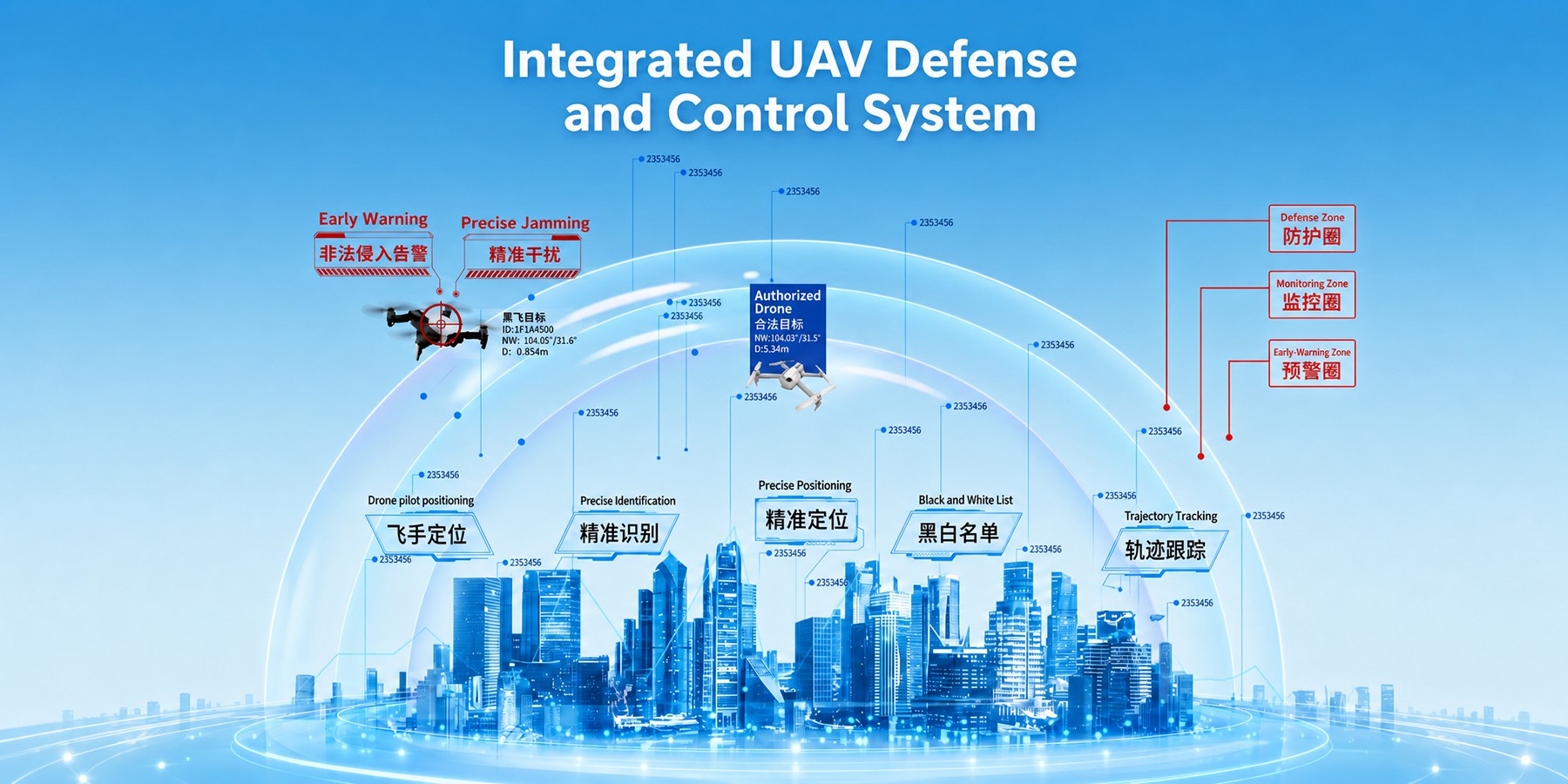
Moving beyond simple detection, WINTOP converts raw frame information into unique "Electronic Fingerprints." This process occurs at the physical layer, where specific signal characteristics are extracted to create a distinct digital signature for each UAV model. This enables precise whitelist/blacklist management, allowing friendly drones to operate while neutralizing threats.
3. Data Layer Information Decoding
WINTOP's capabilities extend into the data layer, where we extract real-time telemetry. By decoding the data stream transmitted by the drone, our systems can accurately pinpoint not only the UAV's position but also triangulate the operator's location on the ground. This intelligence is crucial for situational awareness and tactical response.
4. Control Layer Command Set Reconstruction
The pinnacle of our technology is Control Layer Command Set Reconstruction. By synthesizing data from both the physical and data layers, WINTOP reconstructs the low-level communication protocols used by the drone. This allows our systems to issue precise override commands, achieving seamless precision control and complete electronic takeover of hostile or unauthorized UAVs.
6. FAQ (20 Questions & Answers)
Q1: What is "Radio Protocol Frame Structure Analysis"?
A: It is the process of breaking down the raw signals sent by a drone to understand how they are organized. We analyze the underlying "language" (modulation, coding, synchronization) the drone uses to communicate with its controller.
Q2: How does Physical Layer Demodulation help in drone identification?
A: Every drone model transmits a slightly different signal "shape." Our technology demodulates this signal to extract these unique physical traits, creating an electronic fingerprint that allows us to identify the exact make and model of the drone instantly.
Q3: What is an "Electronic Fingerprint" in the context of anti-drone systems?
A: An Electronic Fingerprint is a unique digital signature derived from a drone's radio frequency emissions. Just like a human fingerprint, it is unique to a specific device or firmware version, enabling positive identification.
Q4: Why is Data Layer Decoding important for security?
A: The data layer contains the actual telemetry sent from the drone. Decoding this allows us to know the drone's flight path, altitude, speed, and even the GPS coordinates of the pilot controlling it from the ground.
Q5: Can WINTOP systems locate the drone operator?
A: Yes. By analyzing the decoded data layer information, our triangulation algorithms can calculate the operator's position, which is critical for apprehension.
Q6: What does "Control Layer Command Set Reconstruction" mean?
A: This is the most advanced feature. It means our system doesn't just block signals; it learns the drone's communication protocol and rebuilds the command set, allowing us to send our own instructions to the drone.
Q7: How does Command Set Reconstruction lead to UAV takeover?
A: Once we have reconstructed the command set, we can issue commands such as "Return to Home," "Land Now," or "Go Up/Down." This gives WINTOP the capability to electronically hijack the drone's flight path.
Q8: What is the difference between jamming and UAV takeover?
A: Jamming simply blocks the signal, causing the drone to hover, land, or return to home based on its failsafe programming. Takeover (via Command Reconstruction) allows for active, real-time manipulation of the drone's flight.
Q9: Does this technology work on DIY or custom-built drones?
A: Yes. While commercial drones have standard protocols, our deep protocol analysis allows us to adapt to non-standard and custom-built communication links, including Frequency Hopping Spread Spectrum (FHSS).
Q10: What role does synchronization play in your analysis?
A: Synchronization sequences are key to locking onto a drone's signal. Our systems use these sequences to establish a stable connection for decoding the rest of the data stream accurately.
Q11: Is this system susceptible to interference from other wireless devices?
A: WINTOP's multi-layered approach includes sophisticated filtering. We specifically target the drone's unique fingerprint, making our systems highly resistant to interference from Wi-Fi, Bluetooth, or other non-target RF sources.
Q12: Can I create a whitelist of approved drones?
A: Absolutely. Using the unique electronic fingerprints generated by our Physical Layer Demodulation, you can easily add friendly drones (like police or security UAVs) to a whitelist to ensure they are never targeted.
Q13: How fast can the system identify a drone threat?
A: The identification process is nearly instantaneous, typically taking less than 1-2 seconds from signal acquisition to positive identification and classification.
Q14: Does decoding the data layer require the drone to be transmitting video?
A: No. Our systems focus on the control link telemetry, which is transmitted constantly during flight, regardless of whether video is being streamed.
Q15: What kind of data can be extracted from the drone's signal?
A: Typically, we can extract serial numbers (Drone ID), GPS coordinates (drone and operator), altitude, speed, heading, battery status, and flight mode.
Q16: Is this technology legal to use for signal interception?
A: WINTOP systems are designed for use in authorized security scenarios (Airports, Prisons, Government facilities). Users must comply with local telecommunications and aviation laws regarding radio signal interception.
Q17: How does this compare to radar or camera detection?
A: Radar and cameras detect the physical presence of a drone. WINTOP's protocol analysis detects the communication link. This provides positive identification (knowing it's a drone) and reveals the operator, which radar and cameras cannot do.
Q18: Can the system differentiate between different drones flying at the same time?
A: Yes. Because each drone has a unique electronic fingerprint, our system can track and manage multiple drones simultaneously, distinguishing between them on a crowded spectrum.
Q19: What is a "Pilot Sequence" in your analysis?
A: Pilot sequences are known reference signals inserted into the communication stream by the drone. They help the receiver (our sensor) synchronize and correct the signal for better decoding accuracy.
Q20: What makes WINTOP's approach superior to simple RF jammers?
A: Simple jammers create noise, which can be detected and evaded. WINTOP's protocol-level reconstruction is stealthier and more precise. We don't just disrupt; we control, allowing for non-destructive resolution of threats when necessary.

